Tolerance stack-up answers a simple but critical question: when every manufactured dimension varies within its allowed limits, will the assembly still function?
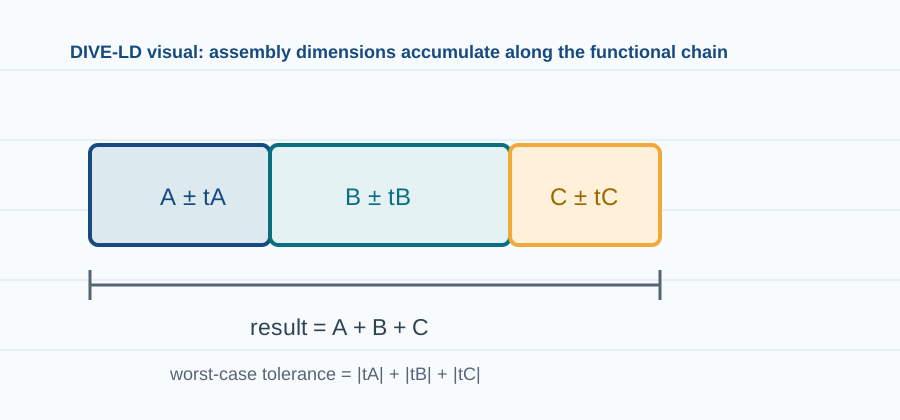
Start with the functional gap
Define the output you care about: clearance, interference, alignment, compression or position. Then create a one-dimensional dimension loop from one functional surface to the other and assign signs to each contributor.
Worst-case stack
Worst-case analysis adds the extreme contribution of every tolerance in the unfavorable direction. For independent bilateral tolerances in a simple linear stack, the total worst-case tolerance is the sum of the absolute component tolerances. It guarantees interchangeability if every input stays in specification, but can be conservative.
RSS statistical stack
Root-sum-square combines independent random variation statistically: square each contributor, add them, then take the square root. RSS can predict a much smaller expected spread, but it relies on assumptions about distributions, centering, independence and process capability.
Do not ignore geometry
Real assemblies are not always one-dimensional. Hole position, angular error, flatness, runout, thermal expansion and flexible parts can dominate even when the linear dimension chain looks acceptable.
Use the stack to redesign
If the stack fails, tightening every tolerance is usually expensive. Better options include shortening the chain, adding adjustment, changing locating strategy, using a slot/floating fastener, or moving precision to a more capable process.
Document assumptions
Record which dimensions are included, whether tolerances are bilateral, what statistical model is assumed and which manufacturing distributions are expected. A stack result without assumptions can look more precise than it really is.
Try the calculator
Use the DIVE-LD Tolerance Stack Calculator for nominal, worst-case and RSS results, then treat the output as a design aid rather than a substitute for process capability data.
Drawing & GPS verification
Confirm the drawing standard named on the product documentation and use the current applicable ISO GPS or ASME Y14.5 requirements.